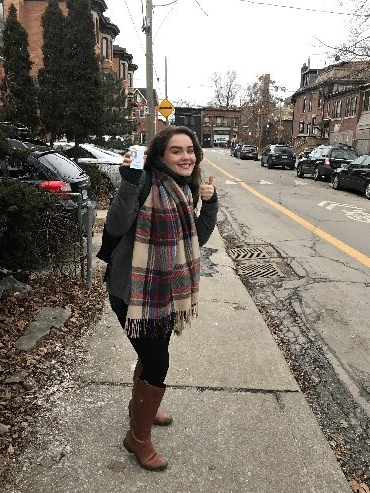
Lisa Rudolph is currently a research technician who received her B.Sc. in Honor’s Physics from the University of British Columbia in 2018. During her undergrad she cultivated a passion for particle physics, neuroscience, and computational physics – with the latter introducing her to machine learning. Her honor’s thesis delved further into the realm of machine learning as it consisted of creating and training an artificial neural network in order to optimize the cavity geometry of photonic crystals. Outside of work, she enjoys traveling, cooking, adventuring around Toronto.
Her latest project was focused on using machine learning to label fMRI images. Traditional methods for labelling an fMRI scan can be laborious, time-consuming, and prone to inconsistencies. Therefore, the alternative method she is looking at is using convolutional encoders-decoders to automatically label fMRI images by brain tissue type – a process known as semantic segmentation.